By Karim Eshqoor, Lawyer, Barbarian Law® (LSO #83032R). First published March 11, 2026; updated October 28, 2026.
Semantic search finds what a document means; Boolean search proves what a database contains. In legal work done with artificial intelligence, use the first to find candidates and the second, plus your own reading, to decide what you rely on.
A search engine can answer one of two questions. Which documents are about this? Or which documents contain this? Legal research has always needed both, and most mistakes come from treating one as the other.
What question does each one answer?
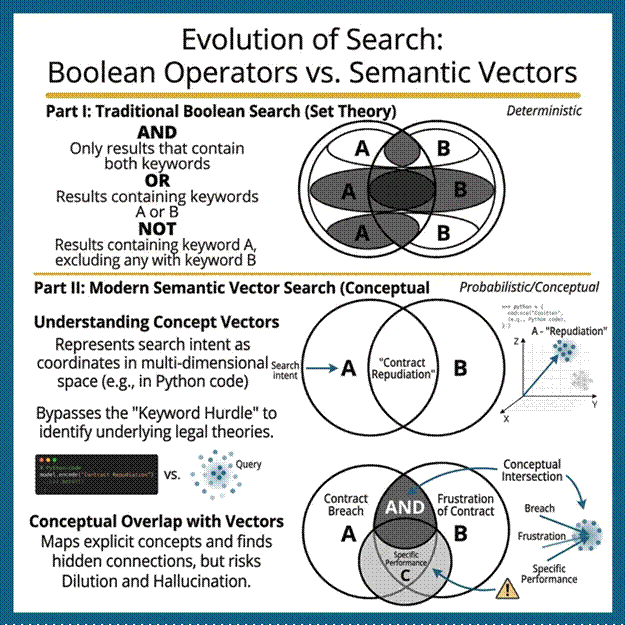
Boolean search answers “which documents contain this.” You write the rule (AND, OR, NOT, a phrase in quotation marks, two words within five of each other, a date range, a court) and the database returns every document that meets it and nothing that does not. It is set theory. The same query in the same database returns the same set tomorrow.
Semantic search answers “which documents are about this.” It converts your question and every document into numerical representations of meaning, then ranks documents by how close they sit to your question. It is geometry, not logic. Nothing has to match word for word; something only has to be near.
What is semantic search good for?
Range. A question about contract repudiation can surface material on anticipatory breach, frustration and specific performance that never uses the word “repudiation.” It catches the doctrine you forgot to name, the synonym the other side’s drafter preferred, and the clause in your own precedent library that does the same job under a different heading.
Boolean cannot do that. It only finds what you already knew to ask for.
Where does it break?
In three places.
Similarity is not jurisdiction. A document can sit very close to your question and come from the wrong province, the wrong level of court, a statute since repealed, or a foreign doctrine that sounds like ours. Closeness in meaning says nothing about whether the source binds anyone in Ontario.
Ranking is not completeness. Semantic tools return the top of a list. You do not see what the model ranked eleventh, and you cannot prove that nothing relevant was left out.
Results are not reproducible. Change the model, the index or the phrasing slightly and the list changes. A colleague re-running your search may not get your answer.
Why does Boolean still matter?
Because it is the only one of the two you can audit.
| Semantic search | Boolean search | |
|---|---|---|
| Question it answers | Which documents are about this? | Which documents contain this? |
| How it works | Ranks by closeness in meaning | Returns exact matches to a rule you write |
| Finds what you did not think to ask | Yes | No |
| Reproducible | Not reliably | Yes; anyone can re-run the string |
| Shows you what was excluded | No | Yes; the rule defines the boundary |
| Can return something that is not in the database | Yes, once a generative layer writes the answer | No |
| Best use | Scouting | Proof |
Seventeen years as a soccer referee taught me the useful version of this. The on-field call is instinct: fast, usually right, occasionally badly wrong. VAR exists because a replay anyone can review beats a confident memory. Semantic search is the on-field call. Boolean search is the replay.
What changes when AI writes the answer?
Most AI research tools are semantic search with a writer attached. The search step retrieves passages by meaning; a language model then writes a fluent answer from them. That adds a fourth failure on top of the three above: the model is built to produce plausible text, and a citation, a quotation or a section number is just more text. When retrieval comes up short, the writer can fill the gap with something that reads correctly and does not exist.
So the risk moves. With a search engine, the danger was missing something. With a generative tool, the danger is being handed something that was never there, in a paragraph good enough that nobody checks it.
Fluency is not authority. The duty of competence under the Law Society’s Rules of Professional Conduct (rule 3.1-2) stays with the lawyer, whatever wrote the first draft.
What should a lawyer actually do?
Five habits, in this order.
Explore wide. Start with semantic search or an AI tool to map the concepts, the synonyms and the doctrines next door. Treat everything it returns as a lead, not a source.
Narrow with rules. Turn the leads into Boolean strings with proximity, phrase and field limits (court, date, jurisdiction) so the result set has a boundary you chose.
Keep the string. Save the exact query and the database you ran it in. If the work is questioned later, you can show how you got there.
Open the source. Every authority you rely on gets read in a primary database: the decision, the court, the date, whether it is still good law in Ontario.
Check quotations word for word. A real source with an invented sentence inside it is the hardest error to spot and the easiest to avoid. Compare every quoted line against the original text.
The same five habits apply outside a courtroom. Barbarian Law® is a transactional firm, and the failure shows up as a share purchase agreement that borrows a clause from the wrong precedent, a lease amendment that cites a section the head lease does not contain, or a reporting letter that paraphrases a by-law instead of quoting it. Semantic search finds the clause that looks right. Exact-text comparison confirms it is the clause that is actually there. More on drafting tools in legal AI inside law firms.
Questions people ask
Is semantic search better than Boolean search?
Neither is better; they answer different questions. Semantic search is better at finding related material you did not know to look for. Boolean search is better at proving what a database does and does not contain. Good research uses both, in that order.
Can I rely on an AI research tool’s answer if it gives citations?
Not without checking them. A citation in an AI answer is generated text until you have opened the source yourself and confirmed it exists, says what the answer claims, and applies in your jurisdiction.
Why does an AI tool invent sources?
Because it is designed to produce the most plausible next words, not to look things up. When its retrieved material does not contain a good answer, it can still write one, and a made-up case name or quotation looks exactly like a real one.
Do I still need to learn Boolean operators?
Yes. They are how you narrow a result set to a boundary you can defend, re-run a search later, and confirm that an authority an AI tool mentioned actually exists in a primary database.
Does any of this matter for transactional work?
It matters wherever a document quotes or relies on another document: agreements built from precedents, leases that refer to head leases, corporate records that cite by-laws. The check is the same: compare the text you rely on against the source, word for word.
Is using AI for legal research allowed in Ontario?
Using AI tools is not prohibited, but the lawyer stays responsible for the work. The duty of competence does not move to the software, so anything relied on has to be verified by the lawyer.
The bottom line
Semantic search to find, Boolean search to prove, a human to read. AI makes the first step faster and the last step more important. The tools will keep getting better at sounding right; the job is still to check whether they are.
Where Art Meets Corporate Interest.
Have a deal or a document in front of you?
Barbarian Law® is a flat-fee transactional firm in Aurora: real estate, corporate and commercial work, wills and notary services.
This article is commentary and general information, not legal advice, and reading it does not create a lawyer-client relationship.