Trust the Process – Rooted in Exhaustive Search
In the evolution of legal practice, the focus is often misplaced on the results—the final memo, the closed deal, the court order. However, as we navigate our research method from traditional Boolean logic to advanced Semantic Search, the most critical lesson for a modern firm is that the integrity of the outcome is entirely dependent on the rigor and method of the process.
To protect a client’s interests in an era of rapid AI deployment, a lawyer must prioritize a scientific approach: a commitment to a transparent, verifiable methodology that prioritizes systemic accuracy over immediate convenience. Under Rule 3.1-2 of the Law Society of Ontario’s Rules of Professional Conduct, this is not merely best practice—it is a professional obligation.1
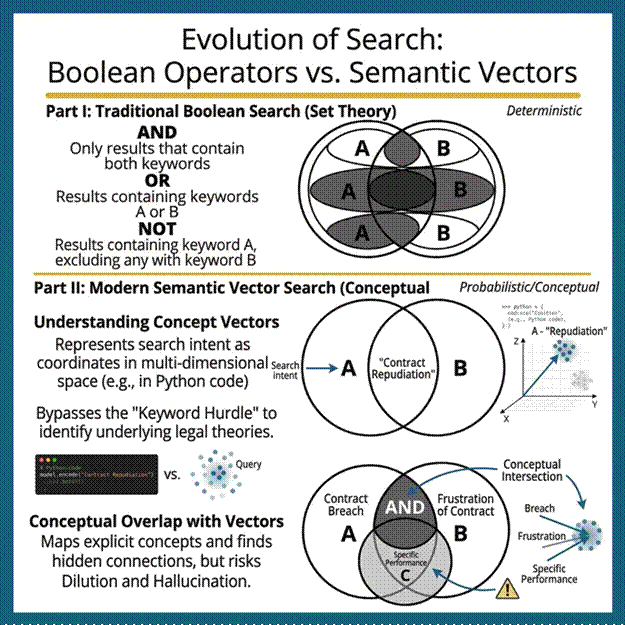
Figure 1: Evolution of Search — Boolean Operators vs. Semantic Vectors
I. The Process of Discovery: Semantic “Scouting”
Most researchers look for the “win” immediately, using narrow keywords to find what they think they need. A superior process begins with a wider lens.
Semantic Search serves as a general scouting report. By mapping “latent meaning” rather than just syntax, it identifies the broader legal landscape. It allows us to ask: What are the underlying theories that haven’t been named yet? And what questions do those answers beget?
The cognitive advantage is that it bypasses the “Keyword Hurdle,” ensuring we aren’t blinded by the specific vocabulary of a single judge or opposing counsel. A semantic query on “contract repudiation,” for example, will surface related doctrines—frustration of contract, anticipatory breach—even when those precise terms are absent from the source document.
The danger, however, is that semantic search can feel like a “Black Box.” If we prioritize speed over understanding, we risk Conceptual Dilution—accepting a result that “looks” right but lacks the jurisdictional precision required for a binding argument. In the Ontario context, a result drawn from another jurisdiction may appear conceptually aligned yet be entirely inapplicable before the Superior Court of Justice.
II. The Hallucination Risk: A Crisis of Information Supply Chain
The obsession with results over process is precisely what leads to AI hallucinations. When a system is asked to produce a “persuasive argument,” it focuses on the output. Without a rigorous verification process, it may fabricate citations to satisfy that goal.
The Law Society of Ontario has specifically cautioned lawyers that AI tools can “produce incorrect or misleading information” and that lawyers remain personally responsible for verifying the accuracy of any AI-generated research before relying on it. The duty of competence does not transfer to the tool.2
For a law firm, your research pipeline is your supply chain. If the process for generating a citation cannot be deconstructed and verified, the result—no matter how polished it may appear—is a liability. On a CanLII search, every result traces to a specific decision number, court, and date.3 An AI’s “confidence” in a result is not a substitute for that lineage.
III. The Deterministic Guard: Boolean Precision
If Semantic Search provides a general scouting report, the Boolean String is the verification tool—the discipline that transforms a promising lead into a defensible finding. Boolean logic (AND, OR, NOT) is the only way to perform a stress test on AI’s conceptual outputs.4
By returning to a deterministic process, we ensure two things: exhaustiveness, meaning we don’t rely on an AI’s relevance filter and find everything within our defined logical boundaries; and auditability, meaning a Boolean query is a reproducible recipe that any auditor, judge, or partner can run and reach the same conclusion.
IV. The Bimodal Strategy: Process as a Defence
Trusting the Process means adopting a Bimodal Search Strategy. We do not choose between the speed of AI and the precision of logic; we integrate them into a defensive workflow. The four steps are: (1) Explore using Semantic Search for conceptual mapping; (2) Isolate using proximity operators to link concept to citation; (3) Verify using Boolean strings for a deterministic, hallucination-free audit; and (4) Finalize through human review for strategic application and confirmation of the Duty of Competence.
This workflow satisfies the Duty of Competence not by avoiding AI tools, but by subordinating them to a verifiable process. The standard does not require perfection—it requires diligence. A Bimodal Strategy is that diligence made systematic.1
Conclusion: Anti-Fragile Research in the Age of AI
A firm that focuses solely on artificial results is fragile: it is one hallucination away from a sanction, a missed authority, or a negligence claim. A firm that focuses on Process is anti-fragile.
By deconstructing the “Black Box” of semantic search and grounding it in the deterministic proof of Boolean logic, we ensure that our research is precise, auditable, and defensible—before any court, any regulator, and any client who asks how we arrived at our conclusions.
At Barbarian Law, process integrity is not a feature of our practice. It is the practice.
Notes
1. Law Society of Ontario, Rules of Professional Conduct, Rule 3.1-2 (Competence), online: <https://lso.ca/about-lso/legislation-rules/rules-of-professional-conduct/chapter-3>.
2. Law Society of Ontario, “Practice Management Guidance: Use of Artificial Intelligence Tools” (2024), online: <https://lso.ca/lawyers/practice-supports-and-resources/topics/the-lawyer-s-duty-of-competence>.
3. Canadian Legal Information Institute (CanLII), online: <https://www.canlii.org>.
4. LexisNexis, “Boolean Search Operators and How to Use Them” (2024), online: <https://www.lexisnexis.com>.